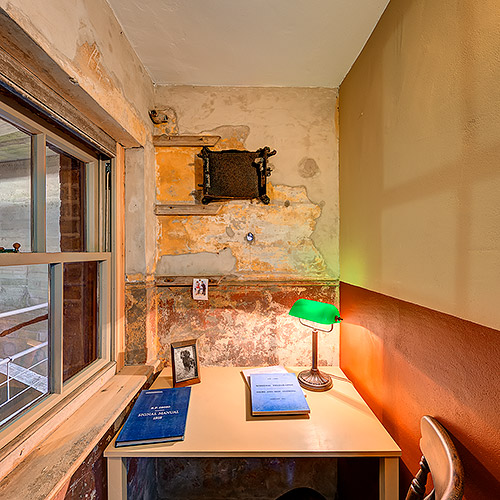
Fire Command Post & Port War Signal Station
Take A 360° Virtual Tour



Take A 360° Virtual Tour
The Fire Commander was responsible for 16 coast defence guns and 14 searchlights. The decision to open fire was his, in conjunction with the Fortress Commander, and in action he was in charge. Today, his office houses an exhibition providing an introduction to the story of Dover during the First World War.
The room contains a timeline and models that show the development of the building and four panels that explain different aspects of the history of Dover during the war.
These models show how the building has developed since 1874.

The four phases are:
Dover has been militarily and strategically important since Roman times for two simple reasons: it is the shortest crossing point to the Continent and it is located on the Straits of Dover, the vital seaway between the North Sea and the Atlantic Ocean.
When war was declared on 4 August 1914, Dover resumed its ancient role. The huge Admiralty Harbour, completed only five years previously as a refuge for the Royal Navy, was of utmost importance. It supported the naval forces that could control the Straits and safeguard troops and supplies going to and returning from France, and it provided safe haven for ships that brought the resources of the Empire to Britain.
Before the war, Dover was designated as a Defended Port, with an army garrison to defend it from land and sea attacks. War triggered a pre-prepared defence plan, and thousands more soldiers and sailors came to the castle, the Western Heights, the town and the surrounding area. Dover became one huge fortress with a garrison to hold the port at all costs.

A November Morning on a postcard of 1914, showing Germany, personified by Kaiser Wilhelm II, looking decidedly nervous about crossing the Channel, as the British fleet waits at Dover.
The heart of the Dover fortress, the castle as seen by a pilot in May 1917. The Fire Command Post and Port War Signal Station, an important control centre during the war, is indicated on the very edge of the White Cliffs.

A soldier guards the White Cliffs of Dover, overlooking the Straits, in December 1914: the imagery of Dover was always powerful.
When war was declared in August 1914, Dover implemented its pre-prepared defence plan and became a Defended Port, a fortress with a garrison of thousands of soldiers.
The soldiers of the garrison defended Dover from landward and seaward attack. They built a string of detached earthworks, trenches, barbed-wire entanglements and strongpoints on the high ground around the town, with checkpoints to monitor comings and goings. Within this secure area, camps of temporary huts, rifl e ranges and training facilities enabled thousands of recruits to train and prepare for active service in the war.
The seaward approaches to the port were defended by 16 big guns and 14 searchlights of the Royal Garrison Artillery. These enabled close defence of the port and longer-range fi ring against hostile ships at sea, all of which was co-ordinated by an offi cer in this room – the Fire Commander.

Men of the Royal Berkshire Regiment, training with a Maxim gun at Dover in 1913. Training was a key role of the Dover garrison in 1914–18.

This map shows (in blue and red) the extensive land defences around Dover in 1915.

A military checkpoint on the outskirts of Dover during the First World War.
The Dover Command, Royal Navy, was very important in the First World War. It included the Dover Patrol, responsible for the Straits of Dover, where ships with troops and supplies were in constant danger from German attack. It was perhaps the most dangerous seaway in the world.
Several hundred ships served in the command at one time or another, mainly destroyers, submarines and motor launches, alongside fishing trawlers and drifters adapted for clearing and laying mines and hunting U-boats (German submarines). Many crews were fishermen and merchant seamen, enrolled in the Royal Naval Volunteer Reserve.
The main roles of the Dover Command were:
None of this would have been possible without the safe anchorage of Admiralty Harbour, the home of Dover Command.

British Naval Airship C 23 A of the Dover Command escorting a convoy and keeping watch for German U-boats.

Among the mostly small ships of the Dover Command were a few larger vessels, called monitors. Like this one, HMS Terror, monitors had over-sized guns for bombarding German troops and military installations in France and Belgium. (Painted in 1918 by Sir John Lavery RA, RSA).
Warships in Admiralty Harbour, Dover at the end of the First World War.
In 1914 Dover was and always had been a military town. With a peacetime garrison in the castle and on the Western Heights, and a busy port, soldiers and sailors were part of everyday life. War brought thousands more.
The number of soldiers swelled from about 3,000 to between 10,000 and 16,000, while increased naval activity brought more sailors. The pre-war population of around 43,000 increased on occasion to over 60,000 as men came and went. Barracks filled up, buildings were converted and hut camps were built to cope with the numbers.
Servicemen enjoyed entertainment at venues in the town and in barracks: mainly concerts and music hall acts, some of which raised money for war charities. The spending power of servicemen brought economic opportunity, alongside the threat of attack and the restrictions of a Defended Port. Restrictions included controlled entry to the town at checkpoints, limits on pub opening hours, and permits for pleasure and fishing boats to use the harbour. And late in 1917, food shortages resulted from U-boats sinking hundreds of merchant ships in the Atlantic.
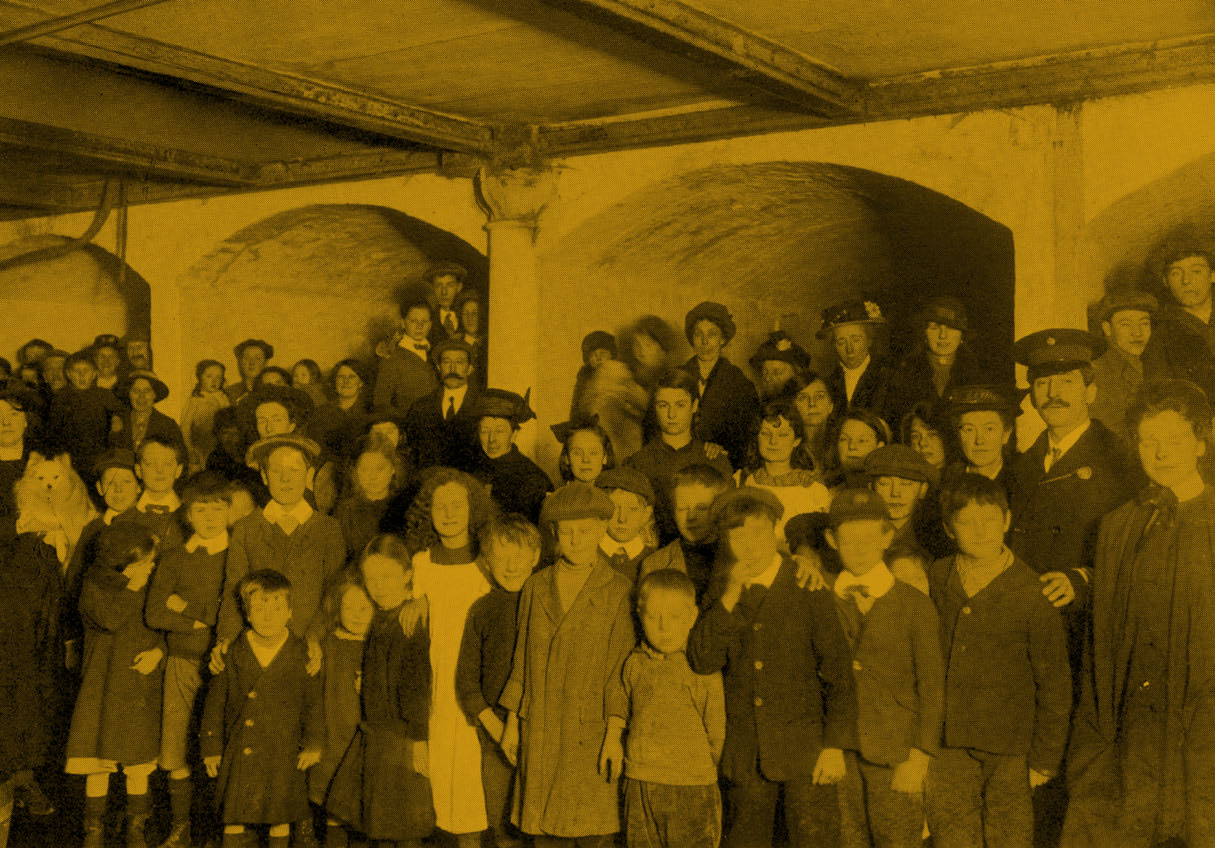
The threat of aerial attack led the Dover authorities to provide air raid shelters. Several large cellars and caves (excavated in the soft chalk rock of the Downs) were used, as in this photograph of Dovorians in the vaults of the Phoenix Brewery.

Entertainment was a regular pastime among the troops and sailors in First World War Dover. Among the many acts was Lance Corporal William John Thomas ‘Billy’ Beer, a local man who joined the Royal Engineers. He was a very popular entertainer, performing over 600 concerts during the war.

Dover suffered bombing raids and a few attacks from the sea by ships and submarines. Each red dot on this map marks a bomb or shell impact: 23 people were killed and 71 injured during the war. Bombs fell quite close to the Fire Command Post and Port War Signal Station.
In wartime, the Dover FC Post protected the Fortress and Admiralty Harbour against attack from the sea, 24 hours a day.
In the First World War, 13 men of the Royal Garrison Artillery (RGA) worked here, in ‘watches’ of 4 or 6 men, on duty for 8 or 12 hours. Their responsibility covered the sea and coast from Folkestone (6 miles west) to St Margaret’s Bay (4 miles east) and the activities of almost 500 men of the RGA and Royal Engineers who manned guns and searchlights.
The table contains maps of Dover harbour showing the areas defended by each gun and searchlight. Enemy ship positions were plotted and decisions taken about which guns to fire.
Orders were sent to the guns from a telephone exchange which connected all parts of the Fire Command.
A small stove provided warmth and hot drinks during longs hours of duty.
The items on this noticeboard illustrate aspects of wartime life for men of the Royal Garrison Artillery (Nos 40 and 46 Companies, and no 41 Anti-aircraft Company, RGA) who worked here in the First World War, 1914-18.
In wartime, the Dover FC Post protected the Fortress and Admiralty Harbour against attack from the sea, 24 hours a day.
In the First World War, 13 men of the Royal Garrison Artillery (RGA) worked here, in ‘watches’ of 4 or 6 men, on duty for 8 or 12 hours. Their responsibility covered the sea and coast from Folkestone (6 miles west) to St Margaret’s Bay (4 miles east) and the activities of almost 500 men of the RGA and Royal Engineers who manned guns and searchlights.
Observers kept watch using stereoscopic binoculars or ‘donkey ears’.
Ships were identified in consultation with the Port War Signal Station partly by using a voice pipe. The sound recording is an imagined conversation about an unidentified ship. The conversation is between the Fire Commander (here) and a Chief Petty Officer in the Port War Signal Station above. The two posts co-operated to identify ships and aircraft before taking action.
Audio script:
The Depression Position Finder enabled a ship’s position to be plotted. Repeated plotting enabled course and speed to be calculated so that guns could fire at the ship’s predicted position at precisely the right moment.
In wartime, the Dover Port War Signal Station enabled the safe movement of Royal Navy (RN) ships into and out of Admiralty Harbour. It also performed essential communications using wireless (W/T) and visual signaling. It operated 24 hours a day.
In this room Watch was kept using binoculars and telescopes for RN ships and for enemy ships and aircraft. Telephones allowed communications with all parts of the RN Dover command and with the military forces of the Dover Fortress.
The rooms on the first floor contained a naval signal station, completed on 3 September 1914, a month after the start of the First World War. It was used to send and receive messages (‘signals’) between ships of the Royal Navy (RN) and the RN shore base in Dover.
At this time the RN was developing a worldwide network of War Signal Stations. Those within Defended Ports were called Port War Signal Stations (PWSS). In wartime, the movement of all ships into and out of Dover harbour was strictly controlled. Staff in the PWSS identified RN warships visually or by exchanging signals, while the ships waited outside the harbour: only then were they permitted to enter port.
Another War Signal Station stood at the end of Admiralty Pier on the west side of Dover harbour. It took on the work of this PWSS when poor weather hampered visibility from the castle. Both stations were manned during the First and Second World Wars.

RN ships in Dover harbour. Every ship had to have its identity checked by the PWSS before entering. The PWSS is just to the left of the wireless telegraph mast above the White Cliffs.

A plan showing Dover harbour in 1912. The red and black pennant marks the location of the PWSS at the end of Admiralty Pier; this became the alternative station from 1914, when Dover Castle PWSS took over the main role.

South-east England in 1912, showing the locations of RN War Signal Stations (black flags) and PWSS (black and red flags). At this time, only Dover and Sheerness had wireless telegraph stations.
In 1914 telephones had been around for almost 40 years. During the First World War, the army and navy in Dover routinely used both military and civilian telephone exchanges to relay orders and to gather and share information.
Telephone communication was essential for efficient, timely command and control of the forces defending Dover. The diagram shows the command structure into which the Port War Signal Station fitted and operated during the war. It reveals not only close co-operation between the armed services, but also with the King’s Harbourmaster. This man, a civilian, was responsible for the safe entry and exit of merchant ships.
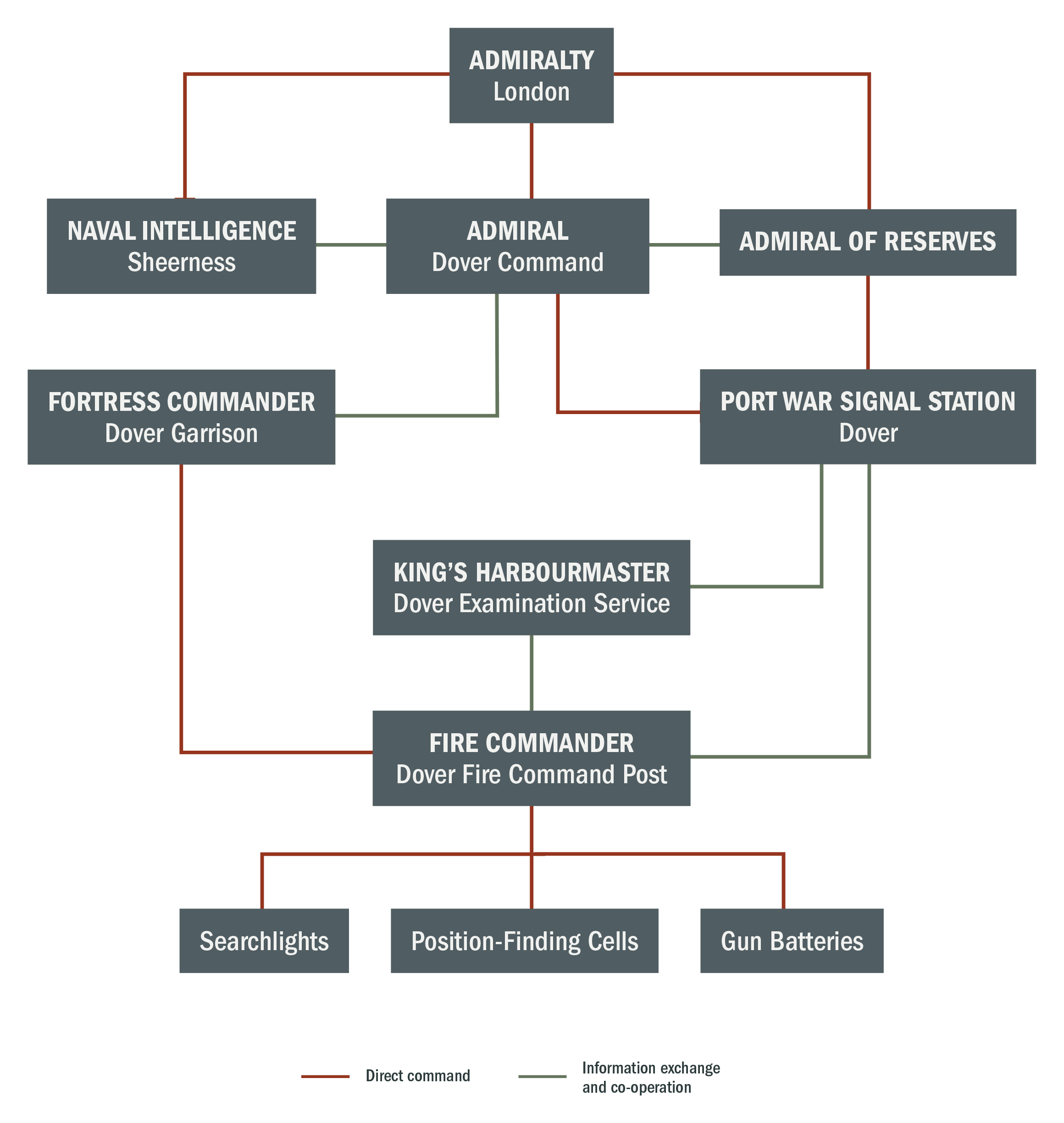
From this room in wartime, naval staff carried out round-the-clock observation of the approaches to Dover harbour from the Straits. They were also responsible for signalling to Royal Navy (RN) warships from the roof above.
The wide window was for watching, with binoculars, for approaching RN ships and potentially hostile ships and aircraft. Those on watch were trained to make quick, accurate identifications and send that information up the chain of command. Orders could then be given to allow entry of a ship, or to alert the naval and military defences – such as the Fire Command Post below.
As you leave through the Port War Signal Station (PWSS) door, to the right are the steps to the roof platform, now blocked by the concrete roof of the cover building constructed during the Second World War. PWSS staff used the roof platform, and later its Second World War replacement, to signal ships – using flags during the day and flashing a lamp at night.

Morse code signals could be sent by light pulses from a powerful lamp, known as the Aldis lamp. It was operated by a simple on-off trigger and powered by a battery, the whole unit being very portable.

Signalling practice in the RN during the First World War. The men are practising semaphore, while the mast behind them is showing a set message.

The flag semaphore alphabet used for visual signalling. Each position represented one letter.
The Royal Navy sent signals between ships, and between ships and shore bases, using flags with unique designs, either singly or in long combinations.
The flags represented individual letters (or numbers) which formed words, or else a single flag could mean a whole command or message - for example, an order to attack the enemy; a manoeuvre; or permission to enter port. The message represented by the flags was known only to specially-trained signalmen, or by consulting a secret signal book.

A Royal Navy warship ‘dressed overall’ with its signal flags, from the Royal Navy signal book of 1918. This full flag dressing from bow to stern was a ceremonial carried out on special occasions and anniversaries, taking advantage of the decorative aspects of the flags.
![King Edward VII [r. 1901-10] on board a British ship after a state visit to France in 1903](assets/images/info/404/01.jpg)
King Edward VII [r. 1901-10] on board a British ship after a state visit to France in 1903. The ship is richly decorated with colourful flags. But the flags were not primarily decorative; each one had a specific meaning and together they represented an entire naval signal.

Sailors hoisting signal flags from the flag locker aboard ship.
Two Port War Signal Stations (PWSS) operated in Dover during the First World War. The castle contained the main one, backed up by another on the harbour wall that took over at times of poor visibility. In those conditions, the harbour PWSS was closer to ships coming and going and could more easily see and control ship movements.
Audio script:
The King’s Harbourmaster in Dover, a civilian, was responsible for merchant ships entering and leaving. To prevent espionage, sabotage and smuggling, he operated the Examination Service, working with the FC Post and PWSS, to ensure ships identified themselves correctly before being allowed to enter. He could inspect any merchant vessel with an armed naval boarding party, under cover of the Fire Commander’s guns.
Audio script:
The PWSS had men of the Coast Guard, the General Post Office, and the Royal Navy (RN) and its reserve forces, commanded by the RN Admiral of Reserves. The demands of war sent many of them to sea, leaving a frequent demand for re-placements at the PWSS. Attempts were sometimes made for a permanent increase in staffing to reduce the strain on men working excessive hours on watch.
Audio script:
Sound of phone hanging up, then, loudly:
In wartime, observers here were a vital part of Dover’s defences: spotting the enemy early might be a matter of life and death.
Binoculars helped to quickly spot and identify ships in the Channel and aircraft flying above it. Posters assisted in identification of friend from foe by highlighting the main features of ships and aircraft in silhouette. How many funnels, masts, guns? How many wings, engines? These were the questions asked of, and answered by, those on watch in the Port War Signal Station.
The Port War Signal Station was connected to the ground floor and to the roof by speaking tubes, a quick method of communication.
A speaking tube is a metal pipe with a cone at each end. Words spoken into the cone travel along the pipe and can be heard at the other end. The cone helps to amplify the words and the pipes were often insulated to contain sound. Sometimes, a whistle attached to the cone was used to attract attention.
Ships were identified in consultation with the Fire Command Post partly by using a voice pipe. The sound recording is an imagined conversation between the Chief Petty Officer (here) and the Fire Commander in the Fire Command Post below. The ship needed to be ‘examined’ before entering port.
Audio script:
In wartime, the Dover PWSS enabled the safe movement of Royal Navy (RN) ships into and out of Admiralty Harbour. It also performed essential communications using wireless (W/T) and visual signalling. It operated 24 hours a day.
This central room provided facilities for working, eating and sleeping. There was a cooker, an all-purpose table, a coding desk, a working station for the W/T operator and folding beds for those on night watch. Hooks and eyes in the roof are probably for hammocks that may have replaced the beds when more staff were needed on duty.
The next four rooms included wireless telegraph equipment for communication with Royal Navy (RN) ships and shore stations. The equipment was in use during the First and Second World Wars, and up to the 1950s.
Sending wireless signals through the air became a reality in the 1890s. The RN quickly established wireless on ships and on shore around the world. Wireless came to Dover in 1901 and moved here in 1914, when it could receive and transmit signals up to 100 miles (160.0km).
The large room provided working and domestic facilities for five men, who encoded and decoded signals and sent them by wireless. Two small rooms provided an office and an officer’s bedroom; a third contained wireless transmitting equipment, switchboard and spares.
The magazines of the Victorian gun battery, below, were adapted for a generator and electric batteries, providing power to the wireless. Signals passed through a huge aerial close by on the castle wall.

Dover Castle, a postcard view from the beach, probably 1918 or 1919; the wireless telegraph mast can be seen clearly.

This is the original plan of the Wireless Telegraphy station and PWSS, as completed in 1914. It was originally heated and lit by gas.
Naval signals, wireless or visual, were often meaningless to the signalmen receiving them. They were usually short groups of letters or numbers forming unreadable sequences. The signals were in code (groups of letters) or cypher (groups of numbers) to make them hard for the enemy, who regularly ‘intercepted’ them, to understand.
When passed on for de-coding, some were easy to unscramble because they represented actual letters and numbers. Others were particular messages, translated by referring to secret code books which acted like a dictionary e.g. the signal CXAK meant ‘Proceed with experimental wireless telegraph trial’
Other sequences had to be re-grouped in several, sometimes complex stages to make understandable messages. This made it more difficult for the enemy code breakers.
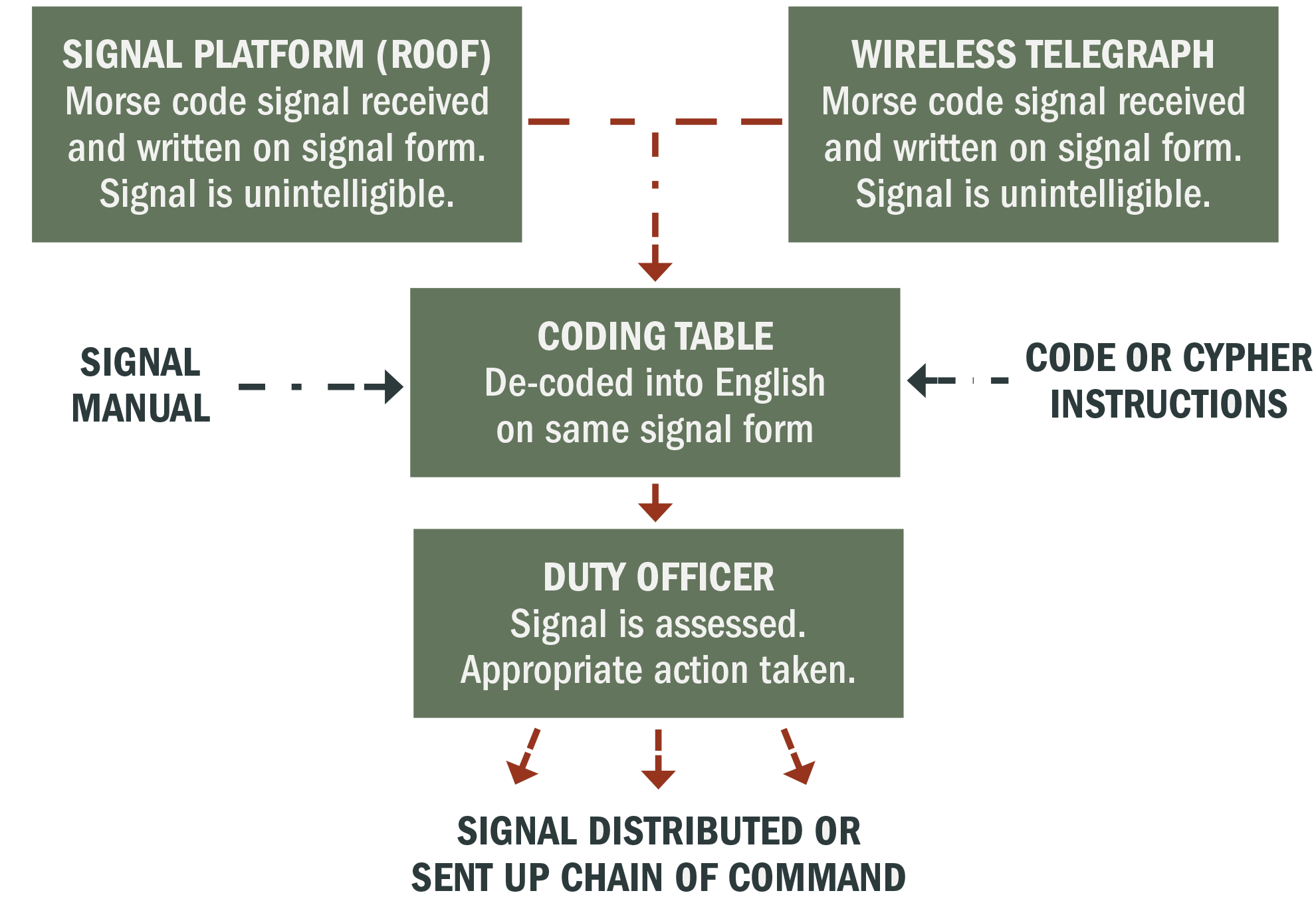

Royal Navy signal manual. These were the responsibility of the signal officers at sea or on land. They were weighted with lead, to sink if thrown overboard in an emergency.
Unlike compact modern radios, wireless equipment at the beginning of the First World War was bulky. The telegraphist worked in the main room, but most of the large and noisy equipment was kept in a smaller room.
Unlike compact modern radios, wireless equipment at the beginning of the First World War was bulky. The telegraphist worked in the main room, but most of the large and noisy equipment was kept in a smaller room.
The telegraphist wore earphones to listen for signals on the correct wavelength, which he identified and isolated with the aid of a multiple tuner. Signals could be re-converted into sound by a magnetic detector and amplified into his earphones. He wrote the Morse code message on a signal form and passed it to a colleague for decoding.
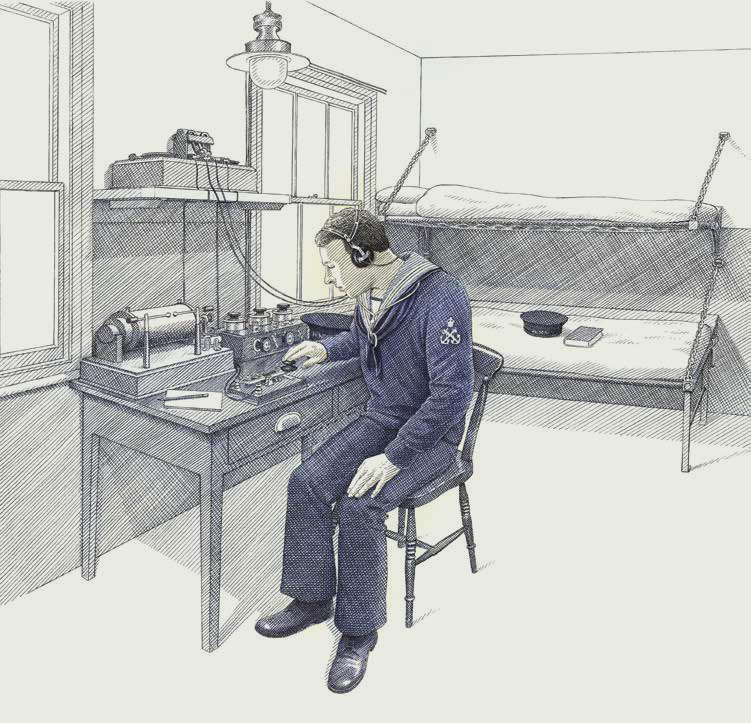
A Petty Officer telegraphist of the Royal Naval Volunteer Reserve, Dover 1916. He is sending a signal using a Morse key. The equipment on the table is a spark-gap transmitter (at left) for generating audible signals, and a multiple tuner (at right), for receiving signals on a particular ‘tune’ or wavelength. On the shelf above is the magnetic detector.
The men of the Port War Signal Station were on duty around the clock, with a change of staff for each 8-hour watch. This room was for the person in charge of the watch; a senior non-commissioned officer (Chief Petty Officer) or a junior commissioned officer (Lieutenant). The room is small but was adequate for the privacy and confidentiality required of an officer in command.
The PWSS was manned at night, when some of the staff might be able to catch some sleep or at least rest when there wasn’t much going on. The duty officer in command of the watch enjoyed this privilege of rank, a private bedroom, while his team all had beds in the main room. Everyone though had the same fold-down beds.
This room contained most of the bulky W/T equipment and a supply of spare parts. Today it includes an exhibit demonstrating Morse code as well as information panels about the technology and about Morse code.
Morse code is an internationally accepted standard for sending and receiving non-voice messages. Originally developed in the 1830s, it was later adapted for use in wireless telegraphy and by flashing lights. Morse comprises unique sequences of sounds or light pulses to represent letters, numbers and punctuation.
Individual letters are composed of short sequences of sound from a tapping key or light from a powerful lamp.
Each letter is separated from the next by a short pause, while longer pauses separate words. Each letter, numeral or punctuation mark has a unique combination of short (dot) and long (dash) sounds or light pulses that can be written down for decoding or immediately translated in the head of a skilled operator.

Royal Navy ships signalling at night by Morse code with flashing lights, to a signal station on the Forth at Queensferry during the First World War.

The most famous example of Morse code is the international distress code, SOS. Another was CQD, popularized as ‘Come quickly, danger. Both codes are illustrated in this image from 1912.
The transmitting equipment sent electromagnetic (‘radio’) wave signals into the atmosphere via a large aerial situated nearby, outside.
Most of the sensitive, valuable transmitting components were in this room, fitted inside a cabinet that was normally kept closed and secure. Transmission was noisy and generated heat, both of which could interfere with the telegraphist’s concentration. So he sent and received signals from the next room.
The electrical wires connecting the generator in the room below, the aerial outside and the transmitting and receiving equipment here and next door came together on a wall-mounted switchboard in this room, enabling quick and simple control of transmission and reception. Spare parts for the wireless equipment were also here, in a large cupboard, so that repairs could be made quickly and efficiently.

Wireless communication was relatively new in the First World War and skilled operators, capable of working and repairing the equipment, were in big demand. Incentives were offered to train but in this case, the Merchant Navy was not necessarily any safer than the trenches.
The roof of the Port War Signal Station (PWSS) formed a signalling platform during the First World War. It was replaced in the Second World War by the current roof.
Signallers on the roof sent messages (‘signals’) to Royal Navy ships in the harbour and Channel, using flags and powerful flashing lamps, and noted incoming messages. Flags were kept in a special weatherproof locker and either used ‘live’ by a signaller or placed in a sequence on the signal mast.

A Leading Seaman signaller of the Royal Navy communicating with a ship waiting outside Dover harbour during the First World War. In 1914, the Dover PWSS had a visual signalling crew of ten, with a mixture of men from the Coastguard, Royal Navy and naval reserve forces.
There has been a harbour here since Roman times: this one was built in stages between 1847 and 1909 and opened by the Prince of Wales, later King George V (r.1910–36).
The harbour enclosed an area of 610 acres (247 hectares) for Royal Navy (RN) ships and 68 acres (27.5 hectares) for merchant vessels. Big guns were mounted on the walls for defence, along with searchlights, so that the guns could fire effectively at night.
The guns and lights were controlled from the Fire Command Post, on the ground floor of this building, by a network of telephones.
On the roof, in the Second World War, signallers from the Port War Signal Station below sent and received messages to and from RN ships, using flags or flashing lamps. They also watched for enemy vessels and aircraft in the Straits of Dover – on a clear day the coast of France can be seen, 21 miles (33.8km) away.

A view of Admiralty Harbour, as imagined in 1898, 11 years before it was ready. The commanding position of the castle (top centre) is evident.

An impression of the German submarine attack on Admiralty Harbour in January 1915, one of four such attacks in late 1914 and early 1915. A submarine periscope is in the centre foreground.
On the distant hill, a tall mast occupies the site of Langdon Battery, where large coast defence guns and anti-aircraft guns watched over Dover and the Straits in the First and Second World Wars.
Much closer, the hexagonal brick building on the cliff edge housed radar equipment during the Second World War. The radar equipment detected and accurately located enemy ships in the Straits and informed the command centre located in the tunnels below you.
The port installations are those of the Eastern Docks. Since the 1950s these have grown into the main cross-Channel passenger ferry port. It was from here that Royal Navy small ships and submarines operated and were repaired during the First and Second World Wars, and where coal and fuel oil was stored on shore.

A 9.2-inch coast defence gun in action during the Second World War, by Eric Ravilious, 1941. Guns like this operated at Langdon Battery, east of Dover, during both world wars.

Light Anti-aircraft Defences: a quadruple Lewis Gun by war artist Anthony Gross, 1941, shows anti-aircraft guns during the Second World War near the Fire Command Post, looking east towards Langdon Battery with the Eastern Docks below.
The Romans built two forts and a settlement, known as Portus Dubris. These were succeeded by a thriving Saxon and a later medieval walled town, all nestled in the valley of the River Dour, which extends inland from the near end of the beach.
At the far end of the beach are the Western Docks, where a new port was established during the reign of Henry VIII (r.1509–47) and provided with gun towers for its defence. The docks have been in use ever since.
Beyond, the ground rises to the Western Heights, where the ruins of a Roman lighthouse, like the surviving example in the castle, stood until the mid-19th century. Enormous defences were built on Western Heights during the wars with Napoleonic France (1793–1815). These defences were continually improved until the end of the Second World War.
On the horizon, the pointed hill is Shakespeare Cliff, so called because of its appearance in the play King Lear.

A 17th-century view of Dover from the west, with the town in the centre and the castle to its right, by Anthonis van den Wyngaerde. In the left foreground are the Western Docks, at that time not long completed.

Observation Post with Gulls by war artist Anthony Gross, 1941, shows the Fire Command Post during the Second World War and the view west to Dover town, Western Heights and Shakespeare Cliff.
To view the 360° panoramas, click and drag on the image.
To view the 360° panoramas, touch the centre of the screen and drag your finger in the direction you with to look.